
Friday, July 24, 2026
Today was a super sleepy day. We cooked a pizza for breakfast – a first for us. We’ve certainly had leftover pizza for breakfast, but actually cooking and eating hot pizza at 9am was new.
Neither of us took a picture today. I was just sitting here wondering what to do about that when Keith said he really wanted to talk about driving in Denmark. Hooray! Here he is, guest writer Keith!
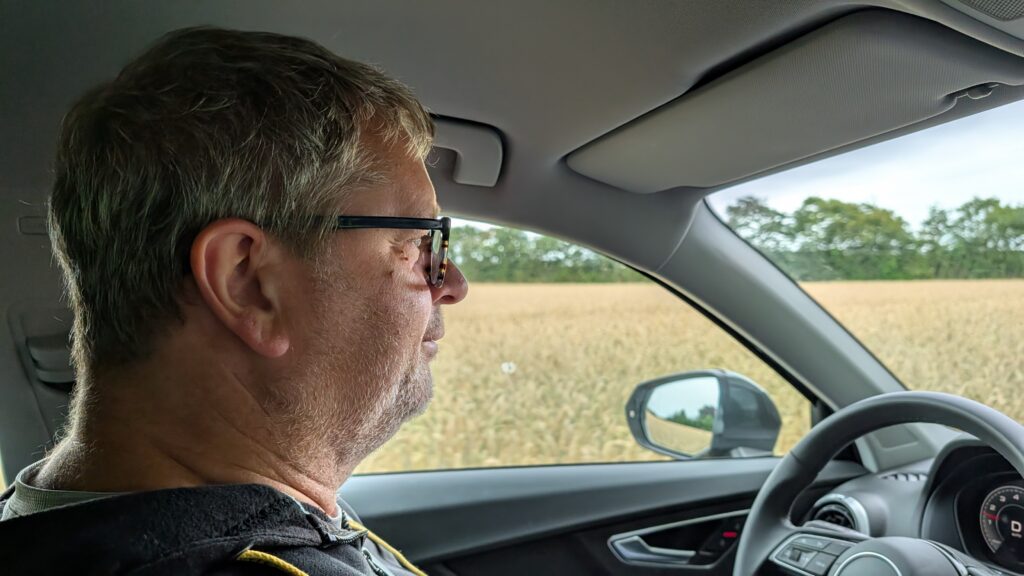
Driving in Denmark was a bit of a learning experience. This wasn’t because of the rules of the road (mostly the same–more on that below) or because they drive on the left (they don’t–right side, just like here). It was that speed limits just magically seemed to change without speed limit signs and the car always knew about these limit changes without the signs too.
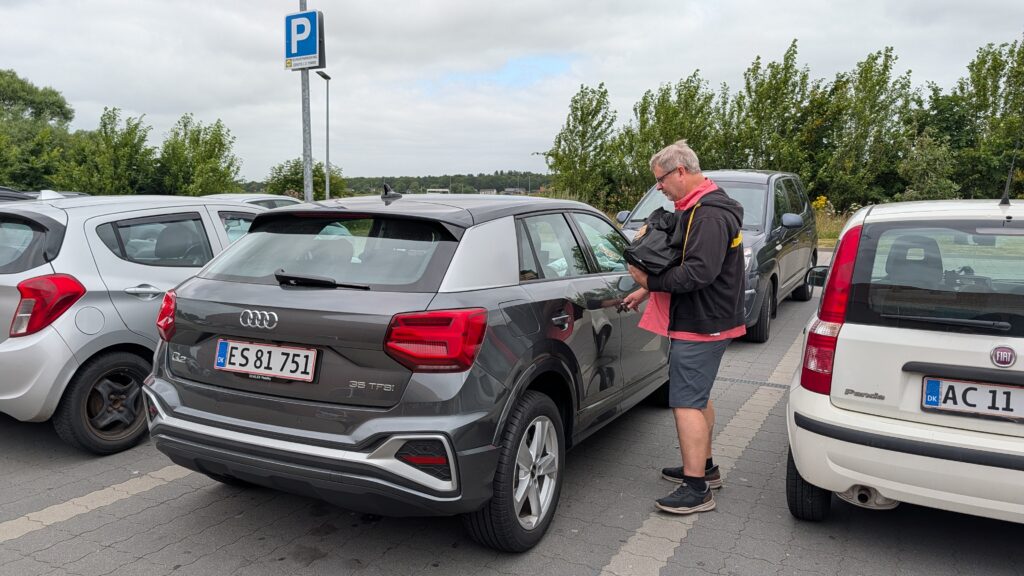
Our rental car was an Audi Q2. It had a pretty magical cruise control. For example, if the speed limit was 50kph and I set the cruising speed to something within a couple kph of that, it would automatically change the cruising speed to match the new speed limit whenever we passed a sign that changed it. Honestly, it was pretty awesome. But, somehow it was smart enough to know the speed should change even when there weren’t any signs. It showed the detected (or magically understood) speed limit at all times on the display. My RAV4 at home reads signs, but doesn’t do some of these other magical things. It turns out the Audi combines live cameras on the car reading signs with live cloud data to determine the correct speed. So, it sometimes had insider information that I didn’t have just by reading the signs and at times it knew there were more signs than just the usual speed limit signs to pay attention to.
The default speed limit in town is 50kph. In the country it’s 80. And on a more major highway it’s 90, 110, or 130, depending on the type of road. Speed limit signs were a bit unusual. The easy one to understand is the usual number in a round white sign with a red border. The number is the speed (kph)–pretty easy. But, sometimes there were signs that were gray and had a grayed-out number with gray lines diagonally across it. I thought of those as “not-speed” signs. A 50 in gray in a light gray circle with diagonal lines across it, I thought of as “not 50”. But, if it’s not 50, what is it? Well, it’s the default for the context (50 in town, 80 in the country, etc.). The tricky part is that sometimes that default was higher and sometimes lower. A not-90 sign might mean 80 or 110. A not-60 may mean 50 or 80. After a couple days I got the hang of that, but sometimes I wasn’t totally sure of the speed limit. The car seemed to magically know at all times, so all I had to do was look below the speedometer to double check my own calculation (or let’s face it, my own guess).
But there was another twist. The car knew to drop to 50 going into town and back to 80 going out of town, even though there are no speed limit signs coming into or going out of town. How did it know? It turns out that every town has consistent black-and-white signs to show that you’re entering a town (with the town name and a little silhouette of a town) and the car could read those signs. When it saw one, it switched to 50. Going out of town, it was the same sign again, but grayed out with a diagonal line through it. The car understood that as 80. It was like magic until I figured out how the car knew. Many towns also had an electronic sign showing your speed that said “Din fart” (“Your speed”) that would angrily flash at you if you were going too fast. Initially I didn’t know why it thought I should be going slower until I figured out these town enter/exit signs and how they magically change the speed limit to numbers you’re just supposed to know.
The car at times was smart enough to slow down in advance of a sign (that was or wasn’t actually there). That’s when it was using cloud data rather than its own cameras. We’d be driving along, there would be no speed limit signs or town signs or anything, then the car would just start speeding up or slowing down. It was pretty weird when it happened, but I learned to just let it happen and after a while understood how it knew about the change. The car usually knew best (although it did like to brake more aggressively than I would’ve wanted when the speed limit was going to drop).
The Danes (obviously) know all these speed rules and for the most part kept close to or under the limit. It was rare to see someone over the limit. I think when it did happen, it was probably another tourist. It was particularly baffling on the fast highways where the speed was 130. Almost nobody was going 130 (most were in the 115-120 range), even when it was clearly posted 130 (it often wasn’t marked–you’re just supposed to know it sometimes–the car knew it). I read that the Danes stick to the slightly slower range because sometimes it dips down to 110, then back up again, and they just stay about 115-120 the whole time to avoid the occasional speed-up-slow-down cycle. Only a very small percentage of drivers went 130. Nobody (and I mean nobody) went above 130. It was actually pretty refreshing to not have all the speeders, but it constantly made me question if the car was right to tell me that the speed was 130. I was a bit uncomfortable going 130 in a 130 zone because I was usually the fastest car when I did (which is a rare thing for me at home–I’m usually one getting passed on the road, not one doing the passing).
I said above there would be more about the differences in the rules of the road. There were only a couple notable things compared to here, but they were important: absolutely never turn right on a red light–always wait at a red light no matter where you’re going; and always use your turn signal when exiting a roundabout. The heads up on the no-turn-on-red thing was emphasized by the rental car company. I learned about the roundabout signaling online. The rental car company also provided one other really important tidbit: gas pump handles are always green, and diesel pump handles always black. This was very important to know because it’s the opposite of here. I’ve also gotta say that the rental company (Alamo) totally wins an award for customer service there. After checking in at the desk (and teaching us these important things), the agent (Agnus) walked us all the way out to our car, told us about returning the car, and answered questions about Denmark and things to see. She was awesome and I’ve never had that personal experience from a rental company anywhere else.
OK, that’s your primer on driving in Denmark. I do wish that I would’ve reset the trip odometer when we picked up the car to know how far I actually drove, because we covered a lot of ground chasing down trolls. We actually drove a surprisingly large percentage of the country. Denmark has almost exactly the same square footage as the Upper Peninsula of Michigan, so it’s not really that large. The best part about all of that driving was that much of the time we were the only car on the road. In fact, it was also rare to see people in towns as we drove through towns too. Small towns (which was most towns) all seemed eerily empty. Apparently, the Danes don’t leave their houses often. Or they were scared of my driving (which seems totally reasonable to me).
You forgot to tell them the car slowed down when there were the arrow signs on a curve. That was cool
So, this just confirms what I learned when I was driving in Scotland in late May/early June – doing even a LITTLE homework if you’re going to drive in a foreign land really helps. While our Volvo didn’t do as cool stuff as the Audi, knowing the variance in rules and etiquette really reduces the stress. And tips on who the nice people are to rent from are invaluable, In the UK, it’s Celtic Legend/Arnold Clark.
The homework really helps. This is only the second time I’ve rented a car outside of the U.S. The other time was Iceland. You can’t do anything in Iceland without a car, unlike a lot of Europe where getting around via trains and subways gets you a long way, but no car in Denmark would’ve been extremely limiting. I spent a bit of time before even setting up a rental looking at driving in Denmark and when I read that it was about as close as driving here as possible, it helped. I’m surprised though looking back at that homework that speed limit was barely brushed on, because that was the biggest learning experience there. I’ve never heard of Celtic Legend/Arnold Clark–I’ll keep that on the list for the future as someday I’ll try driving in the UK and experiencing the wrong side of the road firsthand.
Driving on the left is a TON of fun!!! Once one has prepared, that is… The really good “course” that I took was from an operation called “Trippiamo” – if you rent from Celtic Legend you get 40% off the price. I paid $40, and it was worth every nickel.